

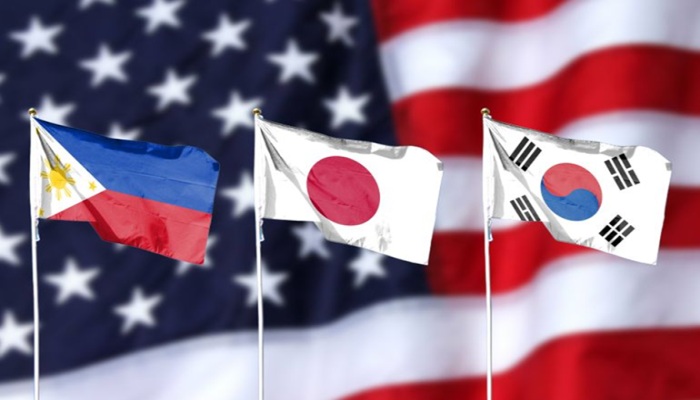
Afrasianet - A report published by the Italian website "Inside Over" by Federico Giuliani dealt with Washington's attempt to revive the idea of a "small Asian NATO" to contain China through a network of alliances that includes Japan ,South Korea and the Philippines, as this project was born out of a previous failure under former President Joe Biden, when the countries of the region refused to engage in a direct American front against Beijing.
The final months of Biden's presidency have seen U.S. attempts to form a kind of "Asian NATO," or rather expand NATO's influence in the Far East, in an effort to contain China.
Giuliani pointed to the former US president's unsuccessful attempt to create a dense network of partnerships and alliances with the region's governments, citing what he described as "a desire on the part of those countries to move away from Beijing's orbit" and his attempt to pull the most strategic allies directly under the umbrella of NATO.
Beijing thwarted its isolation
Biden's pursuit has caused Xi Jinping to intensify diplomacy with developing Southeast Asian countries and the Association of Southeast Asian Nations (ASEAN), while at the same time strengthening economic ties with the region's more mature powers, including Japan and South Korea, thwarting Biden's dual attempts to isolate his country.
A few years after the first failure, the U.S. is once again trying to build a cage around the Chinese "dragon." Unlike in the past, when Biden was in office, the current U.S. administration does not seem inclined to adopt a similar strategy.
In fact, the party most interested in this option is not the White House, but the Pentagon and a significant part of the U.S. military circle.
A Few Countries
The idea of large groupings is unlikely, as the new U.S.-driven "Asian NATO" — if it is to be formed — will consist of a few countries, but with significant geopolitical weight.
From this perspective, Giuliani says, South Korea, Japan, and the Philippines will form what he calls a "strategic triangle" to contain China.
Washington is deploying about 28,500 troops to South Korea, in addition to fighter jets and drones, and the list of allies on which the United States relies is the Philippines and Japan, respectively, necessary to curb Beijing's influence in the South China Sea and to intimidate the Asian giant with the new missile systems that Tokyo is developing.
Doubts, fears, and risks
The irony is that the idea of a "miniature Asian NATO" appeals to only a limited number of parties: the United States, the conservative Japanese government led by Sanai Takanashi, and Taiwan, and the Philippines are not enthusiastic about this vision at all; it believes that "complex contradictions and disparities in the interests of the region" will make any unified military alliance fuzzy and impractical.
Manila was very clear when it said that "there is no objection to military and strategic cooperation, but each country must remain the decision-maker within its own borders," and moreover, as the Japanese example demonstrates, standing with Washington in the face of Beijing practically means that allied countries will be on the front line with China, with no guarantees that they will receive significant support or support from the United States at the crucial moment.
When Sanai Takanashi, at the instigation of the United States, floated her ideas on Taiwan, China's response was violent and sharp, sparking a troubling diplomatic crisis with Tokyo.
Seoul, already forced to coordinate with Washington to deter North Korea, has no intention of risking its trade relations with China.
In short, Giuliani says, it seems that the "mini-Asian NATO" is unlikely to see the light of day.